Ohio
In Ohio, construction is expanding to areas of the future bridge approaches. The most visible work includes the cranes and equipment that will be used to demolish existing bridges and overhead structures. In the 2nd Street area, work will begin on structures connecting the new companion bridge to the surrounding roadway, freeing up nearly 11 acres of green space for future development.
Additional work along U.S. 50 and nearby downtown Cincinnati streets will help prepare the corridor for future roadway improvements.
Kentucky
In Northern Kentucky, crews are working on the west side of the corridor for future connections to the companion bridge. Drivers can expect to see new retaining walls constructed on the west side of the interstate. One wall will be designed to stabilize the hill, while the other provides support for the interstate. This work also creates space to connect the new bridge into the existing highway, while reducing the overall footprint of the corridor.
Although this work may not look like bridge construction yet, it’s a critical step in preparing for construction of the new connections that will tie Northern Kentucky to the rest of the region.
The Riverfront
Along the Ohio River, activity is increasing daily as crews build the Pete Rose Pier, which will serve as an important working dock for the companion bridge construction. The pier will be used to move materials and equipment onto the site. Soon construction will begin on one of the first pylons* for the companion bridge on the Kentucky side. Drivers and boaters will see barges, temporary work platforms and equipment supporting the bridge’s future cable-stayed structure.
Progress You Can See
Not every milestone involves a bridge rising into the skyline. Many of the most important phases of construction happen first, such as building retaining walls, work on Longworth Hall, demolition of the ARTIMIS building, preparing foundations, relocating utilities and creating access for construction crews to carry out the plans.
These early activities are laying the groundwork for a safer, more reliable transportation corridor that will improve travel, reduce congestion and better connect communities throughout the region for generations to come.
A THOUGHTFUL APPROACH TO CONSTRUCTION TRAVEL PLANS
Building a new companion bridge means building new connections and reworking existing roads and ramps leading to both structures. Short and long-term traffic pattern changes will be needed during construction to allow crews to work while still keeping travelers moving through the region. As part of the Brent Spence Bridge Corridor Project, the project team has conducted robust traffic analysis studies and worked closely with first responders and local communities to determine how best to route drivers around construction zones.
In terms of access to Cincinnati and Covington, the guiding principles for this project are to maintain two ways in and out of downtown Cincinnati and one way in and out of Covington both north and southbound. As construction continues, the team will conduct real-time, ongoing traffic analyses to identify any issues and determine if things like traffic signal timing should be adjusted.
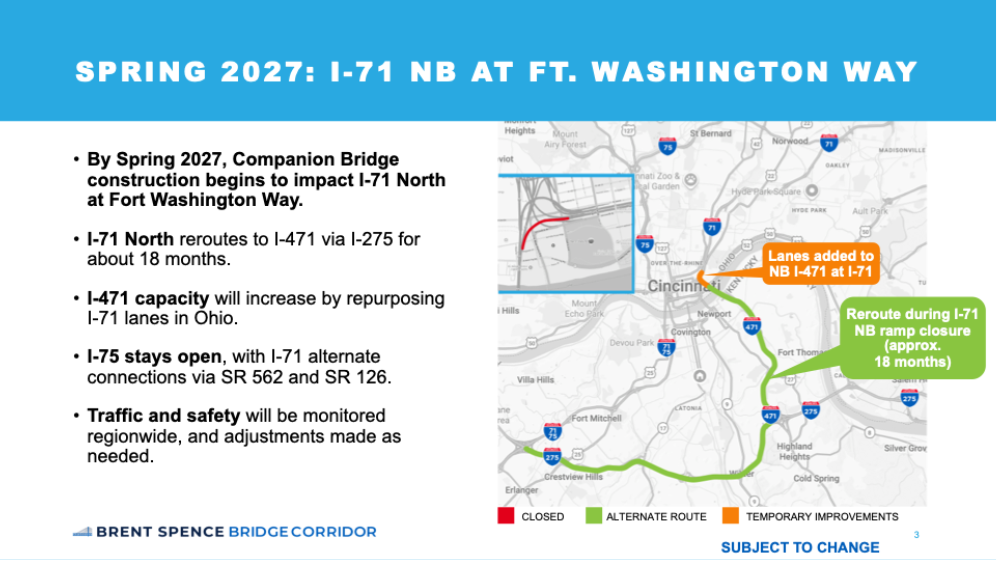
In some cases, this modeling has allowed the team to anticipate problems before they happen and plan measures to address them proactively. Just one example includes the additional lanes being added on I-471 north and southbound at the I-71 interchange in Ohio to accommodate increased traffic from I-71 beginning in mid-2027. Learn more from project managers for ODOT and KYTC in this video. An overview of traffic pattern changes planned for later this year and into 2027 is available below.
A LOOK AHEAD
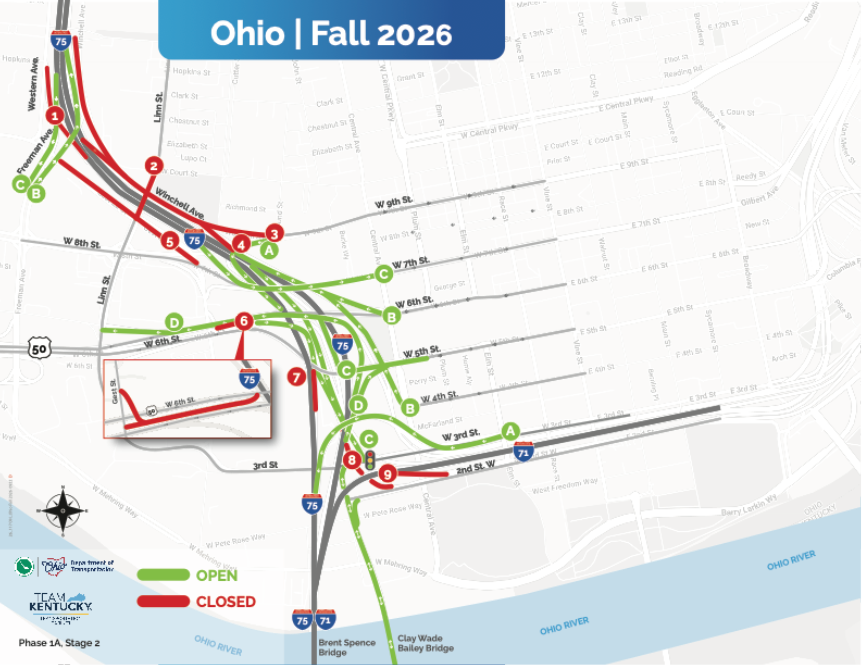
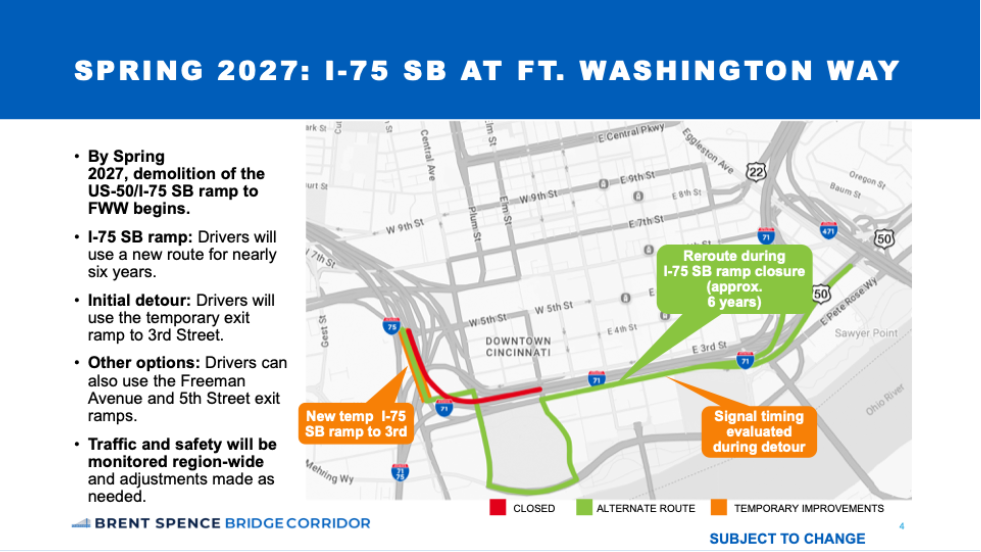
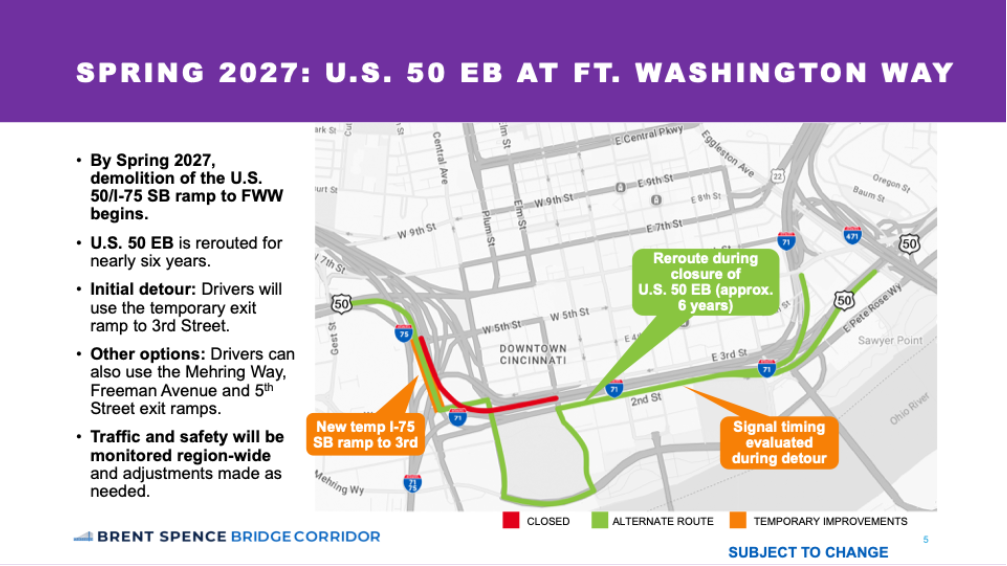
For the remainder of 2026, crews will continue to work on demolition and rebuilding of ramps and access points in both Ohio and Kentucky. In Ohio (see map), a temporary ramp to 3rd Street (letter C) will open in the fall to allow drivers better access to the riverfront district. In addition, the ramp from US 50 eastbound to I-75 southbound will close for several months to prepare the area for construction.
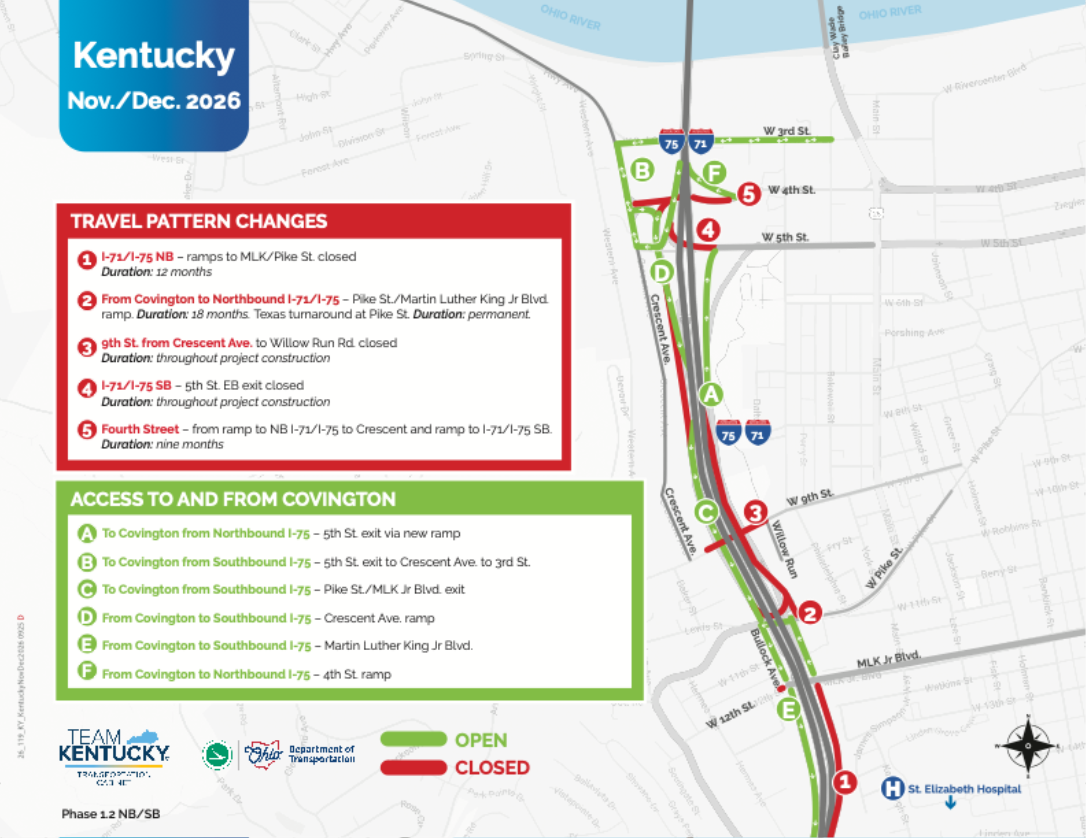
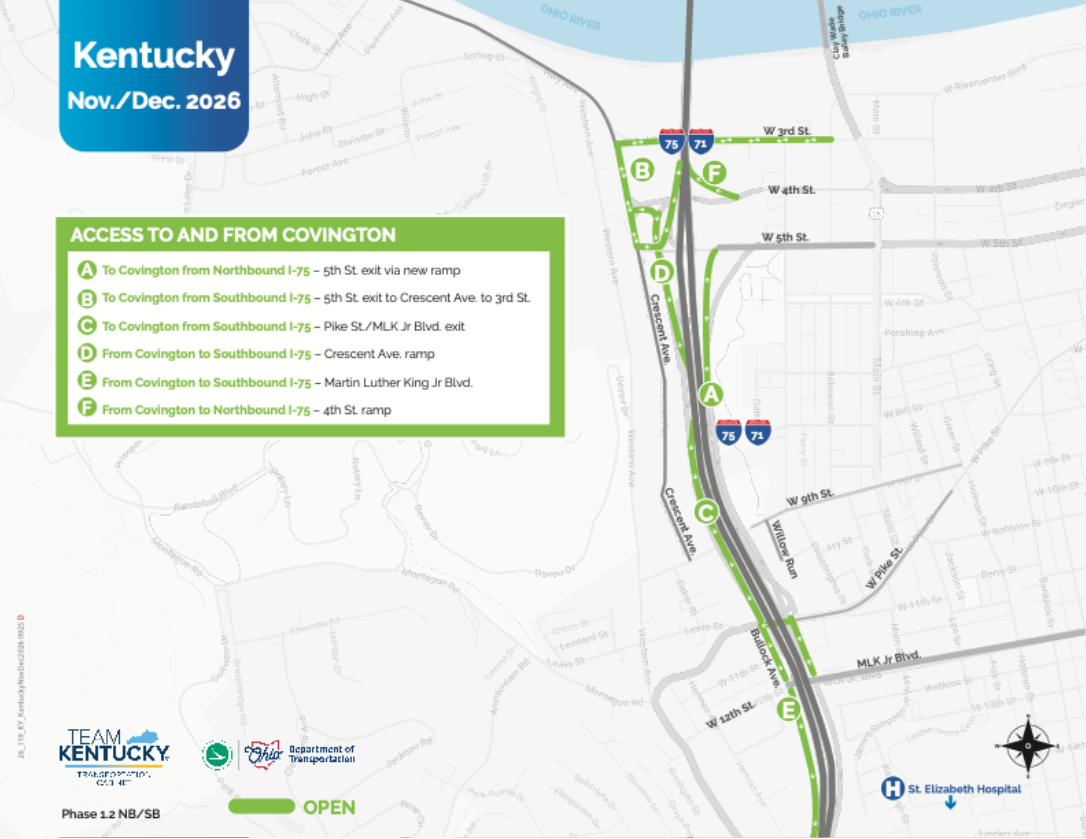
In Kentucky (see map), work continues along both sides of the interstate, including underground utility work and roadway construction. By the end of the year, Bullock Ave., the southbound on-ramp from Pike St. and Martin Luther King Jr. Blvd. will reopen (letter E), as will the 4th St. ramp to I-71/75 northbound (letter F). In addition, the Pike Street on-ramp to I-71/75 northbound will close along with the Texas Turnaround (number 3). To view a map of all routes from the interstate into and out of Covington once these changes are in effect, click here.
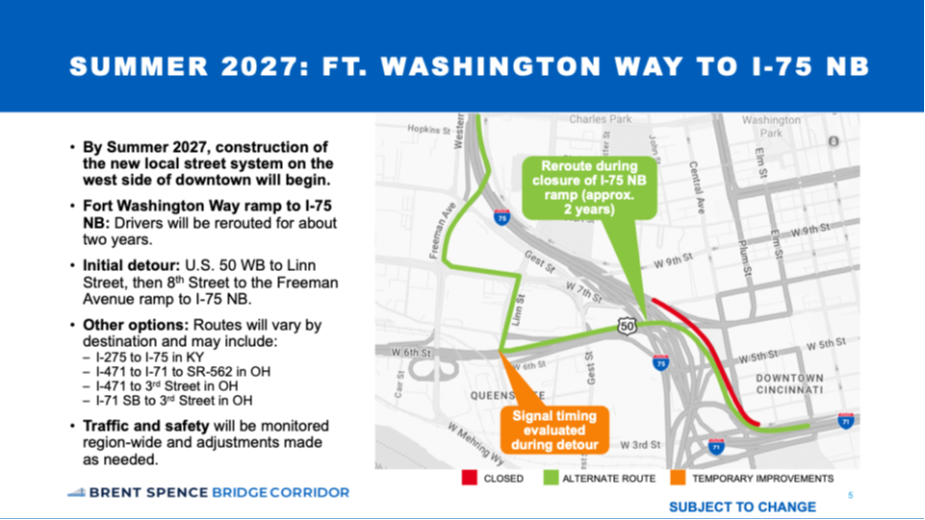
Moving into 2027, crews in Ohio will begin rebuilding connections at the west end of Fort Washington Way (a one-mile stretch of sunken freeway carrying I-71 and US 50 south of the city.) Ramps to Fort Washington Way from I-71 northbound, I-75 southbound and US 50 eastbound will close to support this work, as will the ramp to I-75 northbound from Fort Washington Way. Alternate routes planned during this work are shown on these maps. Overall, I-75 will remain open throughout the course of the project, with the exception of some weekend and overnight closures.
Work in Kentucky will continue along both sides of the interstate to rebuild highway connections as the approach to the new bridge takes shape. As always, the project team provides updates on upcoming closures and travel pattern changes on our website here. Sign up for text and email notifications below to stay informed as changes occur.